
🕷️ Wild Halloween: 10 Real Arthropods That Look Like Supernatural Creatures

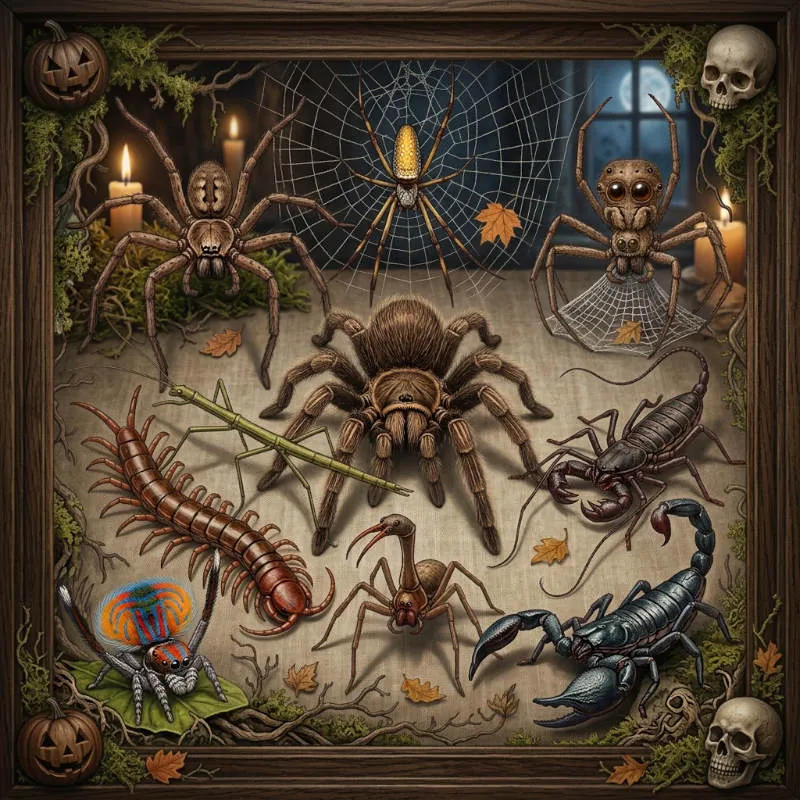
When we think of Halloween, we imagine giant spiders, monstrous creatures, venomous scorpions and beings straight out of a horror film. Yet there is no need to turn to fantasy to find animals with truly extraordinary appearances. Nature has spent millions of years producing remarkable creatures that could easily pass for inhabitants of another world.
Some have enormous fangs, others have extraordinarily long legs, and a few look as though they were designed by a special-effects artist working on a horror movie. There are even spiders that capture their prey by casting a small net, almost like a living trap.
This Halloween, we are exploring the fascinating world of arthropods to discover ten real species that look like supernatural creatures. From the mysterious ogre-faced spider to the impressive Amazonian giant centipede, these animals show that reality can be far more surprising than fiction.
⚠️ Important safety notice: Some arthropod species can cause painful bites or stings and, in certain cases, serious allergic reactions. If bitten or stung by an animal that may be dangerous, seek medical attention.
1. Ogre-Faced Spider (Deinopis): The Hunter of the Night
If there were a competition to find the most unsettling-looking spider on the planet, the ogre-faced spider would be a strong contender. Its enormous forward-facing eyes, unusual features and elongated body make it look like something straight out of a horror film.
But its appearance is not the most extraordinary thing about this spider. Its hunting technique is what really sets it apart.
Unlike many spiders that build webs and wait for prey to become trapped, species in the genus Deinopis create a small net that they hold between their front legs. When an insect comes within reach, the spider rapidly casts the net over it, capturing its prey with remarkable precision.
These spiders are primarily nocturnal. During the day, they remain camouflaged among vegetation, while at night they use their excellent vision to locate potential prey.
Their unusually large forward-facing eyes help them operate in low-light conditions, adding to their almost otherworldly appearance.
They do not need spectacular venom or enormous bodies to look intimidating. Their distinctive faces and unusual hunting methods are more than enough to make them some of the most fascinating spiders in the world.
2. Goliath Birdeater (Theraphosa blondi): The Giant of the Tropical Rainforest
Few spiders can match the Goliath birdeater for size and presence. Native to the tropical rainforests of South America, it is considered one of the world’s largest spiders, particularly when body mass is taken into account.
Large individuals can reach a leg span of around 30 centimetres and weigh more than 150 grams.
Its robust body, thick legs and powerful chelicerae give it an appearance that would not look out of place in a monster movie. When threatened, it may adopt a defensive posture and display its fangs to discourage potential predators.
Despite its intimidating appearance, its diet consists mainly of invertebrates and other small animals. It can also occasionally catch small vertebrates, including frogs and rodents.
One of its most distinctive features is the presence of urticating hairs on its abdomen. When threatened, it can flick these hairs into the air using its hind legs. They can cause irritation and may be particularly uncomfortable if they come into contact with the eyes or respiratory tract.
The spider can also produce a hissing or rasping sound through stridulation, using structures associated with its front legs and pedipalps.
With its impressive size and striking defensive behaviour, the Goliath birdeater looks like a creature designed to star in a tropical nightmare.
3. Emperor Scorpion (Pandinus imperator): The Giant with Black Pincers
Its name alone suggests power. The emperor scorpion is one of the world’s largest scorpion species, reaching approximately 20 centimetres in length.
Native to the tropical forests of West Africa, it stands out for its dark body, enormous pincers and imposing appearance. In dim lighting, its silhouette could easily be mistaken for a fantasy monster.
Despite its fearsome looks, it is not considered one of the most dangerous scorpions to humans. Its venom is generally less medically significant than that of many other species, although its sting can be painful and may cause adverse reactions.
Its large pincers are among its main hunting tools. It uses them to seize and hold prey, which consists primarily of insects and other invertebrates.
Like many scorpions, it is nocturnal and spends much of the day hidden beneath logs, stones or leaf litter.
One of its most remarkable features is its fluorescence under ultraviolet light. Its exoskeleton can glow blue-green, making it appear almost bioluminescent in the darkness.
If Halloween had a king among scorpions, the emperor scorpion would certainly be a strong contender.
4. Golden Silk Orb-Weaver (Trichonephila clavipes): The Weaver of Enchanted Forests
Its enormous webs and striking colours make this spider one of the most spectacular species found in the Americas.
The golden silk orb-weaver, Trichonephila clavipes, builds large, circular webs that can reach considerable dimensions. Its silk has a distinctive yellowish or golden hue, especially noticeable when sunlight catches the threads.
Females are much larger than males and can reach several centimetres in body length. Their elongated abdomens, long legs and contrasting colours give them an appearance reminiscent of the giant spiders found in legends.
Their webs are impressive not only because of their size but also because of the colour of their silk, which may help attract insects under certain lighting conditions.
These spiders feed mainly on flying insects that become trapped in their webs.
Although their appearance can be intimidating, they are not generally considered a major threat to people. Like other spiders, they may bite if handled or threatened, but they usually avoid contact.
Imagine an enormous golden web stretched between the trees of a forest on Halloween night. It is easy to see why this species looks as though it belongs in a dark fairy tale.
5. Peacock Spider (Maratus): The Tiny Creature with Extraordinary Colours
Not every creature that looks supernatural needs to be enormous or frightening. Some stand out because of their tiny size and extraordinary appearance.
Spiders in the genus Maratus, commonly known as peacock spiders, are famous for the spectacular colours displayed by the males and their elaborate courtship rituals.
Many species have abdomens decorated with vivid patterns in red, blue, green and yellow. During courtship, males raise their legs and display their colourful abdomens while performing a series of intricate movements.
The performance resembles a miniature dance. The male moves from side to side, waves his legs and displays his colours to attract the female’s attention.
Their tiny size contrasts dramatically with their striking appearance. Some species measure only a few millimetres, yet their colours and movements make them remarkable members of the arachnid world.
Unlike the large spiders often associated with Halloween, peacock spiders do not rely on enormous webs to catch their food. They are active hunters that pursue small invertebrates.
Their unusual appearance seems more suited to a fantasy character than a real animal. Yet their remarkable colours and courtship displays are entirely natural.
6. Amazonian Giant Centipede (Scolopendra gigantea): A Nightmare with Dozens of Legs
If any arthropod can send a shiver down your spine at first sight, it is the Amazonian giant centipede.
Scolopendra gigantea is one of the largest centipedes in the world. It can exceed 30 centimetres in length and has an elongated body divided into numerous segments, with one pair of legs attached to each segment.
Its appearance is unmistakable: a dark or reddish body, numerous powerful legs and modified front appendages used to deliver venom.
It lives in tropical regions of South America and the Caribbean, where it often shelters beneath stones, logs and leaf litter or among vegetation.
Unlike many other arthropods, it does not feed exclusively on small insects. It can capture relatively large prey, including other invertebrates and small vertebrates.
Its hunting technique is particularly striking. It uses its many legs to restrain prey and its forcipules — modified appendages located near the head — to inject venom.
Its bite can cause intense pain and other symptoms, so it should be treated as a potentially dangerous animal.
Its speed, movements and impressive size make it one of the most intimidating arthropods found in tropical forests.
In a horror film, it would be difficult to imagine a more suitable creature to emerge from the darkness.
7. Giant Huntsman Spider (Heteropoda maxima): Endless Legs in the Darkness
Heteropoda maxima is one of the world’s most impressive spiders because of its extraordinary leg span.
Discovered in Laos, this species can reach a leg span of more than 25 centimetres. Although its body is not particularly bulky, its long legs give it a silhouette reminiscent of a monstrous spider.
It belongs to the family Sparassidae, which includes huntsman spiders that do not rely on webs to catch their prey.
Instead of waiting for insects to become trapped in silk, these spiders actively move around in search of food.
Their long legs help them move efficiently across different surfaces. Their flattened bodies also allow them to shelter in narrow crevices and other confined spaces.
Despite their intimidating appearance, these spiders do not seek to attack people. Like many other arachnids, they generally prefer to retreat when they sense a threat.
Their impressive size and quick movements make them easy to imagine in a science-fiction film.
If a giant spider appeared in a Halloween movie, Heteropoda maxima would be a perfect candidate for the role.
8. Giant Vinegaroon (Mastigoproctus giganteus): The Strange Creature of Nightmares
The giant vinegaroon, also known as the giant whip scorpion, is one of the strangest-looking arachnids in the world.
At first glance, it can look like a cross between a spider and a scorpion. It has a sturdy body, large front pincers and a long, whip-like appendage at the rear.
However, unlike true scorpions, vinegaroons do not have a venomous stinger.
Its name comes from its unusual tail-like appendage, which is primarily sensory. It also has large pincers that help it grasp its prey.
When threatened, it can spray a strongly scented defensive liquid containing acetic acid, which smells similar to vinegar. This distinctive defence explains its common name.
It is primarily nocturnal and lives in warm, relatively dry regions of North America, particularly parts of Mexico and the southern United States.
During the day, it remains hidden in burrows or beneath stones and logs. At night, it emerges to hunt insects and other small invertebrates.
Its appearance is particularly unsettling because of its long front legs, which it uses to explore its surroundings, and its unusual whip-like appendage.
Despite looking like a supernatural creature, it poses little danger to people compared with many other intimidating-looking arthropods.
9. Giant Stick Insect (Phobaeticus kirbyi): The Ghost of the Rainforest
The world of stick insects is full of extraordinary species, but some reach truly remarkable lengths.
Phobaeticus kirbyi is one of the longest stick insects known. It can exceed 30 centimetres in body length, without counting its extended legs.
Its extremely elongated body and slender legs allow it to blend in with branches. This camouflage is one of its main defences against predators.
Native to Borneo, this insect lives among the vegetation of tropical rainforests, where its branch-like appearance helps it remain almost invisible.
Its body can display different shades of brown or green, depending on the species and individual. These colours contribute to its remarkable ability to blend into its surroundings.
Unlike the predators featured earlier in this article, the giant stick insect is herbivorous and feeds on leaves.
Its appearance can be quite deceptive. When it remains still among the branches, it looks like just another part of the tree. When it begins to move slowly, however, its true nature becomes apparent.
On Halloween night, discovering one of these insects among the branches could feel like encountering a creature from another world.
10. Pelican Spiders (Eriauchenius): Hunters with a Monstrous Appearance
The final creatures in our journey are among the strangest spiders in existence.
Spiders in the genus Eriauchenius, known as pelican spiders, have a highly unusual body structure. Their head region and chelicerae extend forwards, forming an elongated shape that resembles a bird’s beak.
This feature gives them an extraordinary appearance that is very different from what most people associate with spiders.
Their anatomy is linked to a specialised hunting strategy. They feed mainly on other spiders, which they can capture using their elongated chelicerae.
Rather than relying solely on direct contact with their prey, their unusual anatomy allows them to keep potential victims at a distance while attempting to capture them.
Many pelican spider species live in Madagascar, where a variety of these unusual-looking arachnids have been documented.
Their appearance is reminiscent of a fantasy creature, with an elongated head and jaws that seem designed for catching other animals.
The most fascinating part is that their anatomy is not the work of a fantasy artist. It is the result of millions of years of evolution.
Pelican spiders show that the strangest creatures in nature do not need to be large to be truly remarkable.
Halloween and Arthropods: When Nature Outdoes Fantasy
Giant spiders, fluorescent scorpions, venomous centipedes and insects that look just like branches. The world of arthropods is full of animals that seem designed to star in a horror film.
Yet behind their extraordinary appearance are fascinating adaptations. Their colours, shapes and behaviours serve specific purposes, such as hunting, defence, reproduction and camouflage.
The ogre-faced spider demonstrates how nature can develop remarkable hunting techniques. The Goliath birdeater shows just how large a spider can become, while the emperor scorpion reminds us that even intimidating-looking animals may behave very differently from what we imagine.
Meanwhile, peacock spiders and giant stick insects show that extraordinary creatures do not have to be dangerous.
Halloween is the perfect opportunity to discover these animals from a different perspective. Beyond myths and legends, real arthropods offer some of the most surprising stories in the natural world.
And the best part? There is no need to invent monsters to find them. Many of these extraordinary creatures already live on our planet.
⚠️ Important safety notice: Some arthropod species can cause painful bites or stings and, in certain cases, serious allergic reactions. If bitten or stung by an animal that may be dangerous, seek medical attention.


