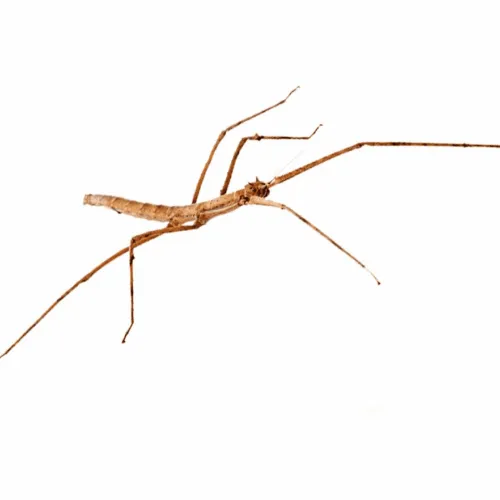
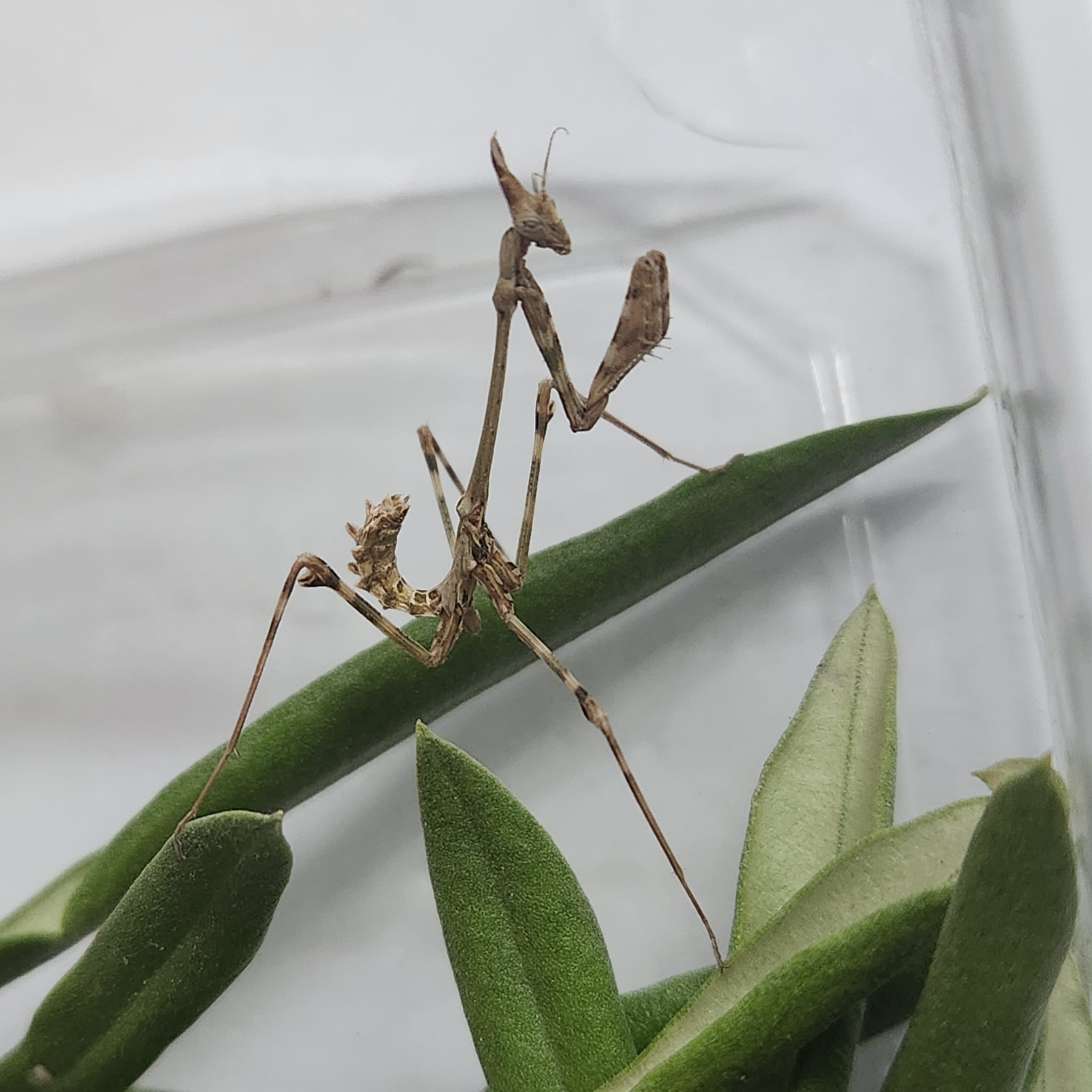
Empusa hedenborgii
15,00€
Technical Sheet — Empusa hedenborgii
- Scientific name: Empusa hedenborgii
- Family: Empusidae (slender, crested mantids)
- Geographic distribution: Spain, parts of Portugal, France, Lebanon, central and southern Italy, and Greece.
- Size:
- Females: up to 10 cm
- Males: smaller, lighter body
- Distinctive appearance:
- Cone-shaped projection on the head visible from birth
- Color variations: green, beige, white, with purple hues in some specimens
- Males have feather-like antennae
- Body structure:
- Long, slender thorax, curved abdomen
- Forelegs with spines for catching prey; long, thin hind legs
- Flight ability: Both sexes have wings, but males fly more easily than females
- Habitat: Warm, dry areas such as grasslands and scrublands where they camouflage easily
- Camouflage and behavior: Patient ambush predator, remains still and strikes quickly at small insects or arachnids
Description
The Empusa hedenborgii looks like it came out of an ancient dream. From the very start of its life, it displays that peculiar “horn” on its head — a magical touch that defines its identity. Its slender body resembles an elongated leaf traced by a delicate stem, with thin legs like fragile twigs. Its colors — from muted greens to beige shades with purple highlights — provide perfect camouflage in the shifting light and shadows of the Mediterranean scrubland.
When still, it barely reveals itself, except for that unmistakable profile. But in the hunt, it’s pure spark: in a blink, it seizes prey with its spiny forelegs, like a living vegetal spear. Males, light as winged metaphors, take to the air effortlessly; females, in contrast, seem to carry a heavier secret when they rise.
Living near one is to feel the magic of the everyday: a creature that blends visual subtlety with an almost ancestral heritage, dressed in simplicity and mystery, hidden in plain sight until it chooses to surprise you.
| Options | L3 – L4 |
|---|
Related products
Dola larvae (pachnoda)
Sold out
Dola larvae (Pachnoda): the nutritious and easy-care solution for your pets! With their diet rich in fruits and vegetables, they are an excellent source of protein and contain virtually no fat ideal for ants, arthropods, reptiles and amphibians. Choose the best for your pets!!
Caribena versicolor
Sold out
Discover the charming Caribbean versicolor tarantula for your terrarium. With its beautiful coloration, it is a perfect addition for any spider fan. We recommend having previous experience with tarantulas or arachnids in general. Bring beauty and fascination to your space with this captivating species.
Grammostola porteri (Rosea)
Sold out
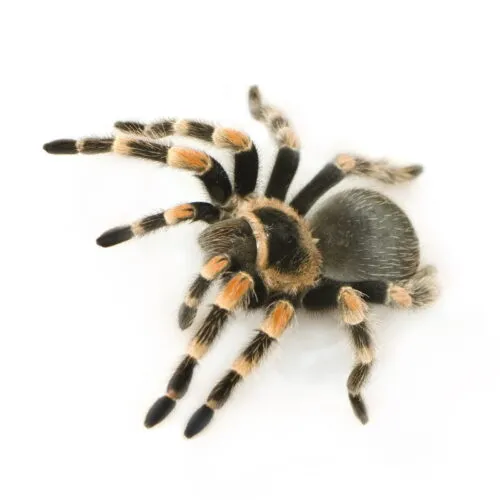
Discover the fascinating company of the Grammostola porteri tarantula! With its unique beauty and adaptability to different terrariums, this tarantula is perfect for beginners in the world of exotic pets. Dare to explore the magic of nature in your home with this captivating tarantula. 🕷️
Porcellio laevis dairy cow
Sold out
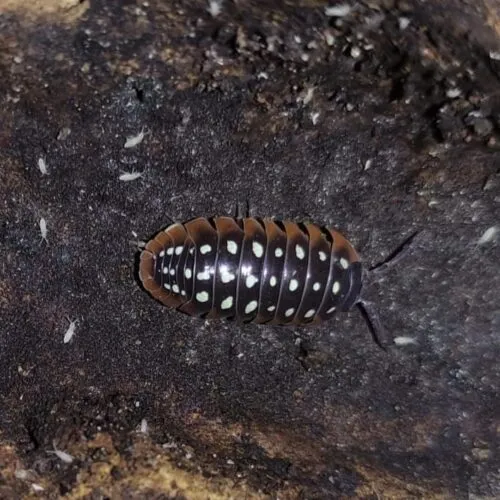
Discover beauty in miniature! Purchase your own Porcellio laevis Dairy Cow and add a unique touch to your terrarium. Bring your environment to life with these fascinating isopods! 🐄
Gromphadorhina portentosa
there is stock
Discover the fascinating Madagascar hissing cockroach! Perfect as an exotic pet or for research projects. Its peculiarity and ease of care make it a unique choice. Dare to explore the world of these incredible creatures!
Lucihormetica verrucosa
there is stock
Discover Lucihormetica verrucosa! Unique cockroach with green bioluminescence and warty exoskeleton. Perfect for studios or hobbyists.
Trichorhina tomentosa
there is stock
Discover Trichorhina tomentosa (dwarf mealybug), a live food for small animals such as reptiles or microfauna in bioactive terrariums. It is a food very rich in calcium. Also for ants and insects in general.
* The value (ml) is the total of the tub with the cochineal + substrate.
Springtails (Tropical white)
there is stock
Tropical white springtails are perfect for bioactive terrariums. They act as a natural clean-up crew, controlling mold and breaking down organic waste. Also ideal as live food for reptiles, amphibians, and arthropods. Easy to keep, fast breeding, and essential for a balanced ecosystem.