
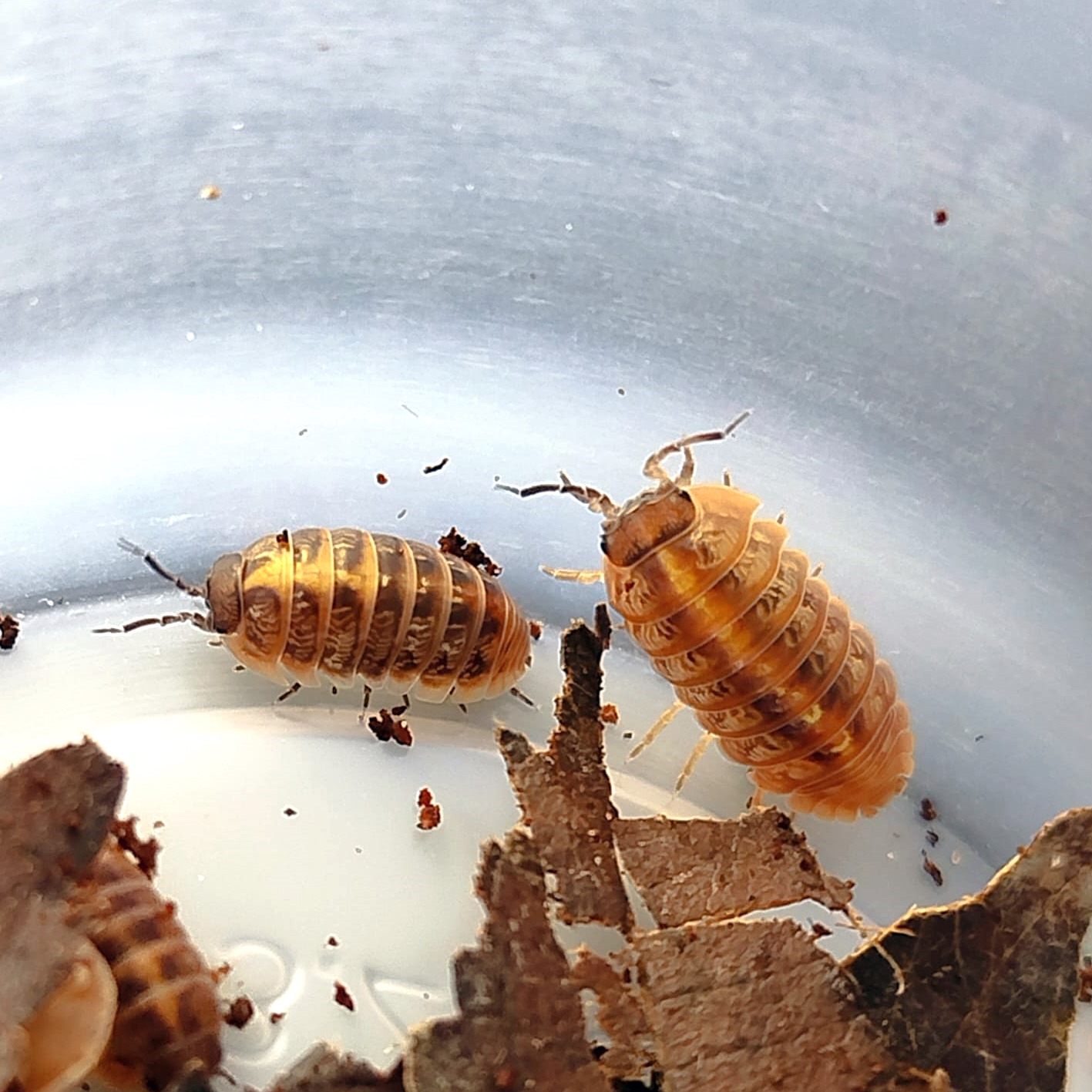
Cubaris sp. "White Side"
Price range: 2,00€ through 8,00€

Food for springtails
2,00€
Armadillidium vulgare “Mocca”
Price range: 1,50€ through 6,00€
Discover the fascinating Armadillidium vulgare “Mocca”: a unique chocolate brown isopod that not only beautifies your terrarium, but also helps maintain a healthy ecosystem. Perfect for hobbyists and nature lovers. Add one to your collection today!
Description
Technical Data Sheet: Armadillidium vulgare “Mocca”
Common Name: Pill bug, roly-poly, woodlouse, isopod “Mocca”
Scientific Name: Armadillidium vulgare “Mocca”
Taxonomic Classification:
- Kingdom: Animalia
- Phylum: Arthropoda
- Class: Malacostraca
- Order: Isopoda
- Family: Armadillidiidae
- Genus: Armadillidium
- Species: A. vulgare
- Variety: “Mocca”
Physical Description:
- Color: Characteristic chocolate brown (“mocca”) color.
- Size: Between 8 and 18 mm in length.
- Shape: Oval and convex with the ability to roll into a perfect ball as a defense mechanism (volvulation).
- Antennae: Two pairs of antennae, with the second pair being longer and more prominent.
- Legs: Seven pairs of legs.
Habitat:
- Distribution: Widely distributed worldwide, especially in temperate regions.
- Environment: Moist soils rich in organic matter, under stones, logs, and fallen leaves.
Behavior:
- Diet: Detritivore, feeding on decomposing organic matter such as dead leaves and rotten wood.
- Activity: Nocturnal, seeking humid conditions to avoid desiccation.
Life Cycle:
- Reproduction: Oviparous. Females carry the eggs in a ventral pouch until the young hatch.
- Development: Undergoes several molts before reaching maturity. The full life cycle can last from 1 to 3 years, depending on environmental conditions.
Adaptations:
- Defense: Ability to roll into a ball to protect against predators.
- Respiration: Adaptations to breathe in humid environments through pseudotracheae (specialized respiratory structures).
Ecological Importance:
- Decomposition: Plays a crucial role in the decomposition and recycling of organic matter, contributing to fertile soil formation.
- Soil Health Indicator: Its presence indicates a healthy and well-balanced soil in terms of humidity and organic matter.
Care in Captivity:
- Terrarium: Maintain in a humid environment with suitable substrate such as garden soil mixed with leaves and decomposing wood.
- Humidity: High, around 70-90%.
- Temperature: Ideally between 18-24°C.
- Diet: Decomposing plant material, occasionally supplemented with fresh vegetables.
Interesting Facts:
- Name: “Armadillidium” refers to its ability to roll up like an armadillo.
- Behavior: Despite being terrestrial, they descend from marine crustaceans and retain certain physiological characteristics of these ancestors.
Additional information
| Options | 1 unit, 5 units |
|---|
Related products
Sold out

Sold out
Sold out
Sold out
Sold out
Sold out


